State machines
A state machine describes a system that is always in one of a few named modes, and moves
between them when a condition happens: a valve that is open, closing or closed, or a controller
that is idle, heating or cooling. Modelica 3.6 defines this with its own syntax (chapter 17 of the
specification). Diokle translates and simulates these machines, natively and in the browser. This is the example from
ModelicaReference.StateMachines, run as written:
model Counter
  inner Integer v(start = 0);
  block Increase
    outer output Integer v;
  equation
    v = previous(v) + 2;
  end Increase;
  Increase increase;
  block Decrease
    outer output Integer v;
  equation
    v = previous(v) - 1;
  end Decrease;
  Decrease decrease;
equation
  initialState(increase);
  transition(increase, decrease, v >= 6, immediate = false);
  transition(decrease, increase, v == 0, immediate = false);
  annotation(experiment(StopTime = 12));
end Counter;
On its default 1 s clock, v counts up by two to 6, down by one to 0, and up again:
t  0  1  2  3  4  5  6  7  8  9  10  11  12
v  2  4  6  5  4  3  2  1  0  2   4   6   5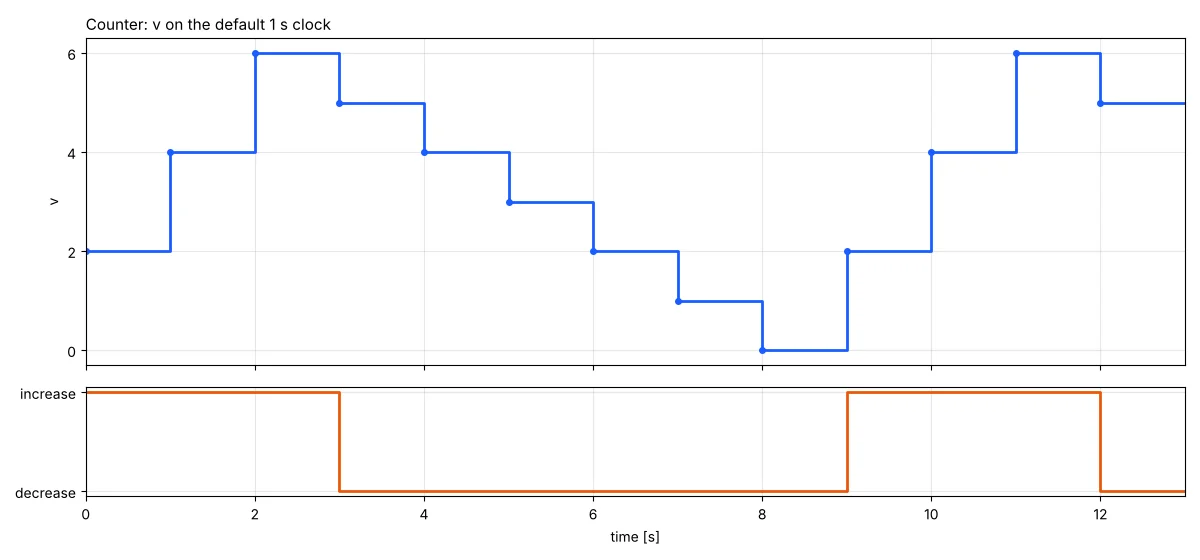
What is supported
Operators
All the chapter 17 operators work:
transition(from, to, condition, immediate, reset, synchronize, priority), where the last four arguments must be parameter expressions;initialState,activeState,ticksInState()andtimeInState().
Transitions
- Immediate transitions fire in the tick where their condition holds. Delayed transitions take effect at the next tick.
- When several transitions could fire, the one with the lowest
prioritynumber wins. - With
synchronize = true, a transition waits until every state machine inside its from-state is in a final state.
Hierarchy
Machines nest inside states, and several machines can run in parallel in one state. An inner machine pauses while its enclosing state is inactive. When the enclosing state is re-entered, the inner machine resumes where it stopped, or restarts in its initial state if the transition resets it.
Variables
- An
outer outputvariable defined in several states gets one merged definition:v = if activeState(s1) then e1 elseif ... else previous(v). inner outer outputvariables pass the merged value of the inner states up to the enclosing machine.- Variables of an inactive state hold their values.
- A reset transition reinitializes the variables of its target state to their start values.
Clock
A state machine runs on the clock inferred for its partition. If no clock can be inferred, as in the example above, it runs on a default periodic clock of 1 s.
Inside clocked partitions, time is now the nominal instant of the tick
(start + k·interval), not the slightly later instant at which the event was
located. This makes timeInState() and comparisons against time exact.
Limitations
ticksInState()andtimeInState()can only be used in transition conditions.- Each equation in a state must be solvable for the variable it defines.
- An immediate transition whose condition reads a variable computed by its from-state in the same tick forms an algebraic loop, which is rejected.
How it works
After flattening, statemachines.rs replaces each state machine by the clocked equations
of section 17.3.4 of the specification: selectedState, activeState, nextState and
their resets per machine, plus the merged definitions of the variables the states define.
The clock partitioning in clocks.rs then runs them like any other synchronous model.
The test models are in crates/daedalus-core/tests/models/statemachines.mo.