Equation and initialization debugger
When a model does not translate, does not initialize, or computes a value you did not
expect, daedalus debug and the Structure tab explain why. Each explanation names
the equations as you wrote them, with their components and source lines.
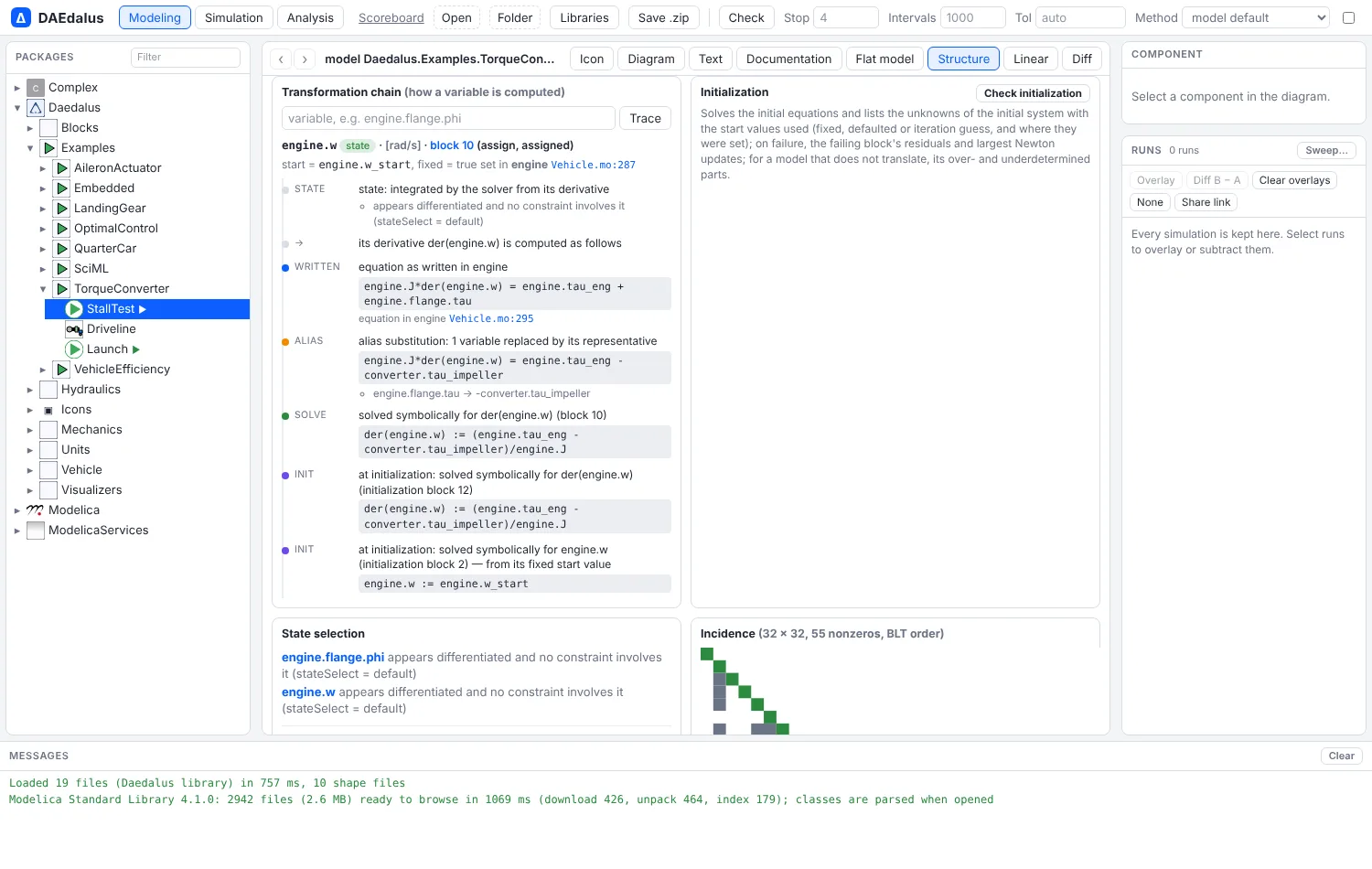
How is a variable computed?
--var follows a variable through every symbolic step: alias elimination, substitution,
differentiation for index reduction, dummy derivatives, solving for it and tearing. Each
step names the equation as written, the component it came from and its file and line.
Two terms come up in the output. An alias is a variable that is just another name for another one, such as the current in two wires joined end to end, so Diokle removes it. A tear variable is one picked to break a loop of equations: the solver guesses its value, then corrects the guess again and again (Newton's method) until the loop balances.
daedalus debug crates/daedalus-core/tests/models/debug.mo -m Debug.DiodeLoop --var d.id.i (alias)
alias of -src.i
block 0 (nonlinear), tear
transformations:
1. [alias] eliminated by alias elimination: relates d.i and d.p.i
d.i = d.p.i
from equation in d at crates/daedalus-core/tests/models/debug.mo:15:5
2. [alias] eliminated by alias elimination: relates r.n.i and d.p.i
r.n.i + d.p.i = 0
from connection [d.p, r.n]
...
8. [source] equation as written in d
d.i = d.Is*(exp(d.v/d.Vt) - 1)
from equation in d at crates/daedalus-core/tests/models/debug.mo:37:5
9. [alias] alias substitution: 1 variable replaced by its representative
-src.i = d.Is*(exp(d.v/d.Vt) - 1)
- d.i → -src.i
10. [tear] tear variable of a nonlinear loop (block 0, 3 unknowns, 1 tear): Newton iterates on it until the residual equations vanish
- tear variables: src.i--equation N does the same for an equation.
In the workbench, the Transformation chain card of the Structure tab shows the chain of any variable or equation you click in the blocks or states. Each source position opens the Text view at that line.
Why does initialization fail?
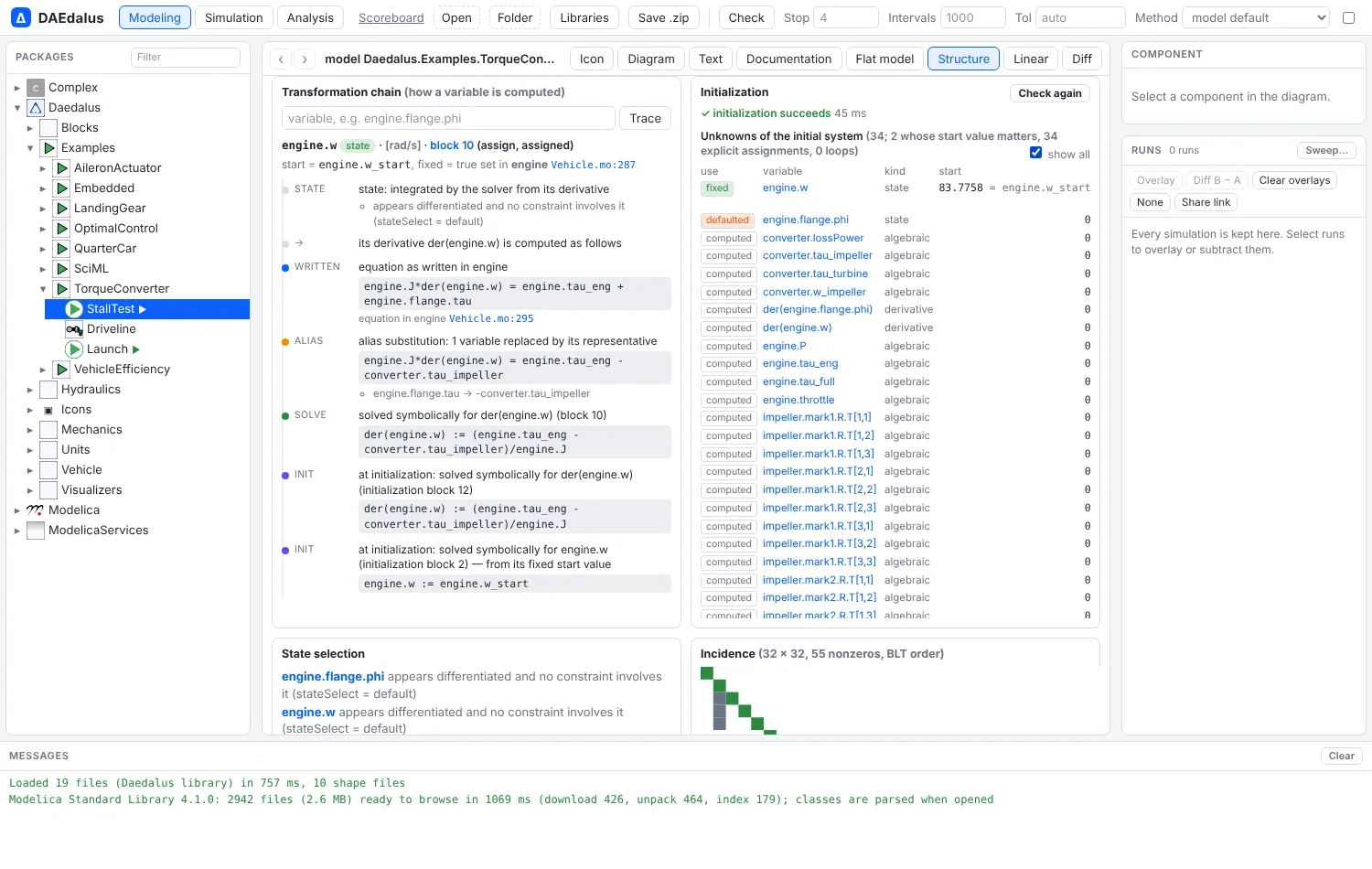
--init lists the unknowns of the initial system and the start values it used. For each
start value it says whether it is fixed or only a guess, and which modification set it.
For a block that fails, it shows the residuals at the last iterate and the variables with
the largest Newton update. A residual is how far an equation is from being satisfied.
A solve has converged when every residual is close to zero.
daedalus debug crates/daedalus-core/tests/models/debug.mo -m Debug.InitFail --initinitialization of Debug.InitFail: FAILED (initialization)
error: initialization: nonlinear system for [b.x, b.y] did not converge at t = 0 (residual 2.839e0)
initial system: 4 unknowns (2 whose start value matters), 2 explicit assignments, 1 loops
start values used:
fixed state s start 0 set in the model at crates/daedalus-core/tests/models/debug.mo:101:20
guess algebraic b.x start 2 (= b.x0) set in b at crates/daedalus-core/tests/models/debug.mo:95:20
loop (initialization block 0): nonlinear with tears [b.x]
initialization nonlinear solve failed at t = 0 (block 0): nonlinear 1 tear variable(s) [b.x], 1 inner
solver residual 2.839e0; diagnostic damped Newton re-run: 50 iteration(s), residual 2.840e0
residual history: 9.39e0 3.72e0 3.56e0 2.90e0 2.85e0 2.85e0 2.84e0 2.84e0 2.84e0 2.84e0 2.84e0 2.84e0
residuals at the last iterate (largest first):
2.8396e0 0 = exp(b.x) + b.y^2 - (-1)
from equation in Debug.InitFail at crates/daedalus-core/tests/models/debug.mo:104:5
hint: the residual stops decreasing at a nonzero value: the iteration sits at a minimum of the residual norm, so the equations may have no solution near these values (check signs, parameter values, and the start values of the tear variables)exp(x) + y² = -1 has no real solution, and the hint says so. simulate prints the same
report when initialization fails. When a nonlinear block fails during a run, it names the
block, the time, the iteration count and the residuals of its equations. In the
workbench, the Initialization card shows the report, and a failed check or
simulation in the Messages panel links to it.
Too many or too few equations
When translation fails, debug finds the smallest under- or over-determined subset of
equations and lists its equations and unknowns with their component paths. A model is
underdetermined when it has fewer equations than unknowns, so some value is never
pinned down, and overdetermined when it has more, so some equations are extra. An extra
equation may be redundant, or it may contradict the others. It also
reports physical connectors that are left unconnected:
daedalus debug crates/daedalus-core/tests/models/debug.mo -m Debug.OpenPin error: model is underdetermined: 6 equations for 7 unknowns (7 variables, 0 of them appear differentiated); no equation for: r3.p.v
structural analysis of the model problem (6 equations, 7 unknowns):
underdetermined subset 1 (0 equations, 1 unknowns):
no equation left for: r3.p.v
components: r3.p
unknowns: r3.p.v
hint: r3.p.v belongs to r3, which has unconnected connectors: none of the 2 physical connectors of r3 is connected: the component has no effect
warning: r2.n (r2.n.i): open end of r2: no current can flow through it (its current is set to zero)
warning: r3.n (r3.n.i): none of the 2 physical connectors of r3 is connected: the component has no effectConnectors whose unconnected flow is zero by the language rules, such as an open output
terminal, a free flange or a lone ground, only get notes. Over the 551 example models of
the MSL 4.1.0 and the Daedalus library (550 of the 551 flatten), this gives two warnings.
Both are real (an earth resistor whose pin is left open in the transformer examples), and
there are no false positives.
See also Structure and state selection for the block structure and the Jacobian.